
What to do if you want your kid to be the next Warren Buffett?

Rule no. #1: Never lose money.
Rule no. #2: Don’t forget rule no.1 – Warren Buffett
Warren Buffett’s words are a guiding light for success in life and finances.
According to Forbes, he is the tenth richest man in the world, with a net worth of $135 billion as of 2024.
He advises youngsters to start investing as early as possible to take advantage of the power of compounding. He started investing at the age of 11 and began investing in real estate at the age of 14.
Having a mentor at his early stages of investing brought tremendous success throughout his life. He studied stock under Benjamin Graham’s mentorship while pursuing his business degree at Columbia University.
He believes in the power of compounding, let’s look at how compounding can build financial stability for your kid – The Warren Buffett’s way
Five benefits of early investing and compounding interest.
If you are a parent of a child under 13 years old, you are at the correct juncture. If you start practising the five benefits, your child will thank you later.
Sounds Good?
Here we go!
Warren Buffett might give parents five key pieces of advice for teaching their children under 13 about financial literacy. One person who understands the importance of investing early is Warren Buffet, one of the world’s most successful investors. He has often credited compounding as a tool to build wealth. According to Morgan Housel, Buffett started investing at age 10 and earned his first million by age 30.
Housel wondered what would have happened if, instead, Buffett was a typical person who spent his money in his teens and early twenties, had a net worth of $25,000 at 30, and retired and stopped investing at 60. He estimated his net worth in this instance would be about $12m today, a staggering 99.99% less than Buffett’s current net worth of $120bn.
Time allows your investments to weather the storms of the market volatility and take advantage of the power of exponential growth. Even if you you start with a relatively small investment, the compounding effect can work wonders over several decades.
How Does Compound Interest Grow?
To help you see the power of compounding in action, here’s the story of Ben and Joe – two guys who got serious about investing for retirement. They picked good growth stock mutual funds that average an annual return of about 11%—just under the long-term growth rate of the S&P 500.
(Note: Since mutual funds don’t earn a fixed interest rate, we’re using the average annual return to calculate the compound growth of their investments.)
Ben
- Starts investing at age 21
- Invests $2,400 every year
- Stops contributing money at the age of 30
- Total amount contributed: $21,600
Joe
- Starts investing at age 30
- Invests $2,400 every year
- Contributes money until age 67 (a total of 37 years!)
- Total amount contributed: $88,800
At age 67, Ben’s investment has grown to over $2.1 million, and Joey’s has grown to over $1.2 million! Nine years made a difference of close to $1 million.
For parents aspiring to fund their children’s education, starting an education fund early and allowing it to grow can significantly ease the burden of exceptional expenses when they arise.
The chart below assumes that someone can start saving at age 13. They save $500 per year from age 13 through 19. At age 20, they begin saving $1,000 per year, and at age 25 begin to save $3,000 each year until age 67. Someone who doesn’t start saving before age 25 and contributes $3,000 each year until 67 would potentially end up with less money—all else being equal. The saver who started later may need to save more each year if they wanted to catch up with the early saver.
This is just one example of how starting early can help save for retirement—shorter-term goals like education or buying a home can benefit too! Find out how teens and even young children can start saving and investing for their future today.
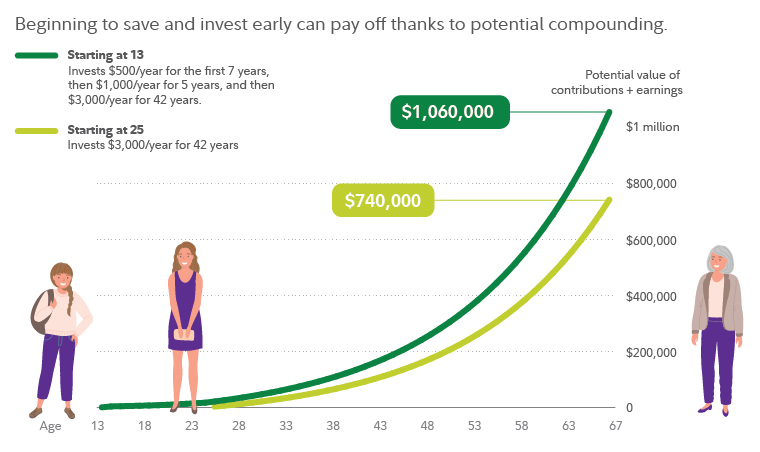
ref. Fideltiy
The best time to start investing was yesterday, but the second-best time is today. Whether you’re a recent college graduate or approaching retirement, understanding and applying the principles of compounding can significantly impact your financial well-being.
Remember, time is crucial to the compounding equation and when combined with the principles of compounding, it can transform your financial future. By committing to save and invest consistently, diversifying your portfolio, and giving your investments time to grow, you position yourself to unlock the full potential of compounding.
So, start today, stay patient, and let the power of compounding work its magic over time.
It’s not about how much you earn, but how soon you start investing.